Why Agencies Need an “AI Operating System,” Not Just a CMS
For the last 15 years, the answer to “I need a website” has been “WordPress.” It powers 40% of the web. It is the default.
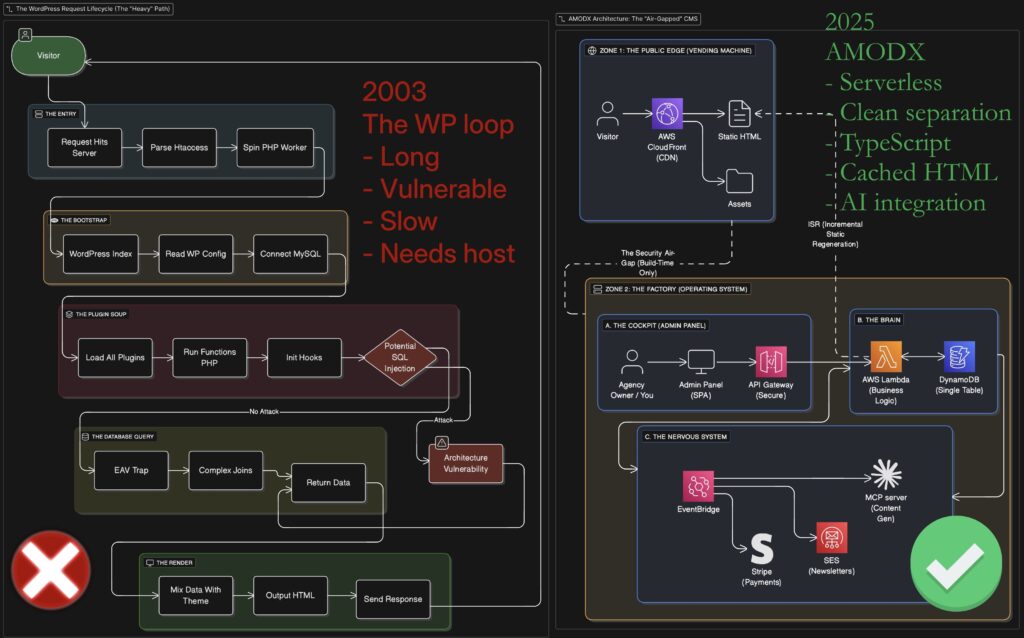
But for a modern agency or a technical founder, WordPress has become a bottleneck. It is a legacy monolith designed in 2003 for blogging, now held together by a fragile ecosystem of plugins.
I am building AMODX, a serverless, open-source WordPress Alternative designed for the AI era.
I am not building it because I hate WordPress. I am building it because I hate friction.
The Problem: Implementation Gunk vs. Idea Flow
In the Art of Gig, there is a concept called “flushing the gunk.” – similar to what James Altucher, a writer, investor, and podcaster, emphasizes that you must generate a huge volume of ideas (including mediocre ones) to find the gems, much like flushing a dirty hose to get clean water.
- Idea Gunk: The bad marketing ideas, the wrong copy, the weak strategies. You want to flush this out fast to find the gold.
- Implementation Gunk: Plugin updates, database connection errors, PHP version conflicts, slow server response times, security patches.
WordPress forces you to wade through Implementation Gunk every single day. If you want to test a new marketing funnel, you spend 4 hours configuring plugins and 1 hour writing copy.
AMODX is designed to invert that ratio. It uses a Serverless Architecture (AWS Lambda + DynamoDB) to remove the infrastructure drag. But more importantly, it changes how you create content.
The Killer Feature: “Context-First” AI Generation
The biggest friction in using AI (Claude, ChatGPT) for marketing is Context.
Every time you open a chat, you have to explain: “I am an agency selling X to audience Y. My tone is Z.”
Existing CMSs (WordPress, Webflow, Contentful) store Content (the final blog post).
AMODX stores both Context (the strategy) and Content.
How It Works (The MCP Integration)
AMODX treats your Strategy, Personas, Pain Points, and Funnel Logic as first-class database objects – hidden from the public, but visible to the AI.
Because AMODX implements the Model Context Protocol (MCP), I can connect my local Claude Desktop directly to my live CMS database.
- The Old Workflow: Copy-paste context into ChatGPT -> Generate text -> Copy-paste into WordPress -> Fix formatting -> Publish.
- The AMODX Workflow: I open Claude and type: “Draft a landing page for the ‘Angry Dad’ persona based on our Q3 Strategy.”
- Claude queries the AMODX database to read the “Angry Dad” profile and “Q3 Strategy.”
- Claude drafts the content using that exact context.
- Claude calls the create_page tool to push the page directly to the staging URL. Or just makes a draft that you can then proofread and approve in the admin panel.
This isn’t just a CMS. It is an Agentic Command Center.
The Comparison: AMODX vs. The Giants
If you are looking for a WordPress alternative, you usually look at Webflow. Here is why I am building something different.
VS. WordPress (The Legacy Monolith)
- WordPress: A database of HTML blobs. Security is a nightmare because the server executes code on every visit.
- AMODX: A database of Structured JSON Blocks. Security is absolute because the public site is a static render (Next.js) detached from the database. There is no wp-admin.php for hackers to brute-force.
VS. Webflow (The Designer’s Tool)
- Webflow: The king of visual design. If you want to drag-and-drop pixels perfectly without code, Webflow wins. But Webflow is a Design Tool, not an Operation System. It is closed-source. You cannot inject custom backend logic (like “Generate a PDF invoice when a form is submitted”) without using third-party glue like Zapier.
- AMODX: Built for Builders. It is “Code-First.” You want to add a custom complex feature? You deploy a Lambda function. You want to orchestrate a multi-step AI workflow? You use EventBridge. Webflow creates beautiful brochures; AMODX creates intelligent business machines.
The Architecture of Speed
AMODX is built on the AWS Serverless Stack:
- Compute: AWS Lambda (Costs $0 when idle).
- Data: DynamoDB (Single Table Design for microsecond access).
- Event Bus: EventBridge (Decoupling the “Save” button from the “Publish” action).
This architecture allows me to deploy a new “Site” in 2 minutes. It handles 1 visitor or 1 million visitors with zero configuration changes.
Why I’m Building in Public
I am documenting this build on The Foundry because I believe the future of agency work is Automated & Sovereign.
We don’t need another way to blog. We need a way to execute strategy at the speed of thought.
If you are a developer or technical founder tired of the “Plugin Soup,” check out the AMODX repository on GitHub. We are building the operating system for the next generation of agencies.
Leave a Reply